Case Study / 2026
Treatment Effect Estimation
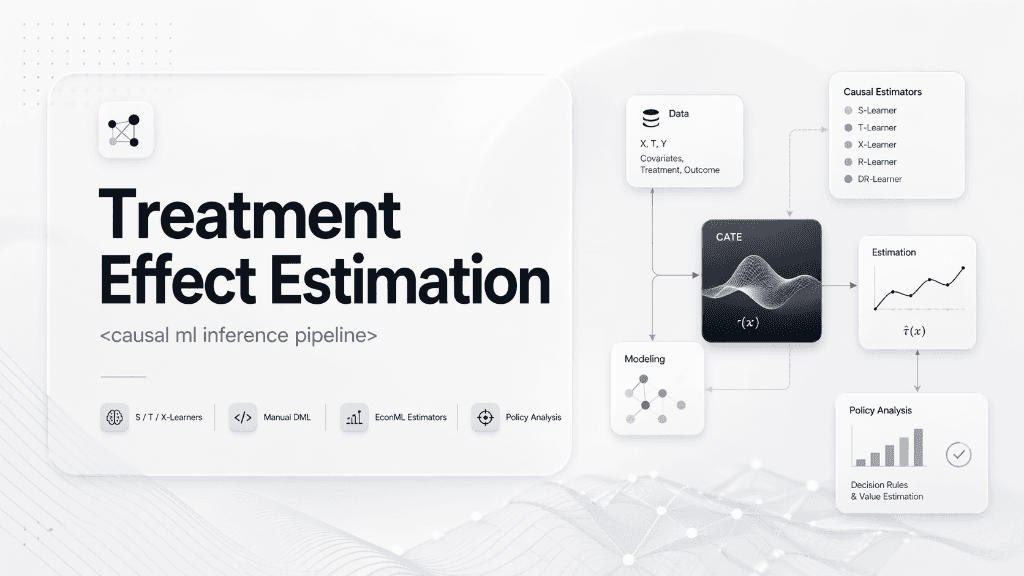
A causal inference pipeline for IHDP treatment-effect estimation, covering naive baselines, S/T/X-learners, manual DML, EconML estimators, policy analysis, and reproducible evaluation artifacts for ATE and CATE.
Project Features
What this case study includes
05 features
Overview
This project turns notebook-based causal inference work into a reusable Python pipeline for treatment-effect estimation on the IHDP benchmark. The goal is not just prediction accuracy, but estimating what changes under treatment and how that effect varies across units.
What It Covers
- Consistent preprocessing, scaling, and aligned train/test splitting
- Naive ATE and propensity-score stratification baselines
- S-Learner, T-Learner, and X-Learner implementations
- Manual DML plus EconML `LinearDML` and `CausalForestDML`
- Evaluation outputs for PEHE, ATE error, policy curves, and artifact export
Why It Matters
The project shows applied understanding of causal ML beyond standard predictive modeling. It moves from notebook experimentation into a runnable pipeline with reproducible outputs, evaluation artifacts, and model interpretation support.
Stack
- Python
- scikit-learn
- EconML
- DoWhy
- SHAP
- pandas